
A suspicious email, compromised staff account, lost laptop or ransomware warning can quickly become a serious operational concern for a medical practice. The first priority is to protect patients and maintain safe care while establishing what happened.
A suspected cyber incident does not always mean patient information has been breached. The practice needs a structured response: contain the threat, preserve evidence, understand the impact, assess legal obligations and restore systems safely. This guide expands on those steps for Australian healthcare providers.
At a glance: your first-response priorities
- Act promptly: alert your incident lead and IT/security provider.
- Protect patient care: activate safe downtime and clinical continuity procedures where necessary.
- Contain carefully: restrict compromised access without unnecessarily destroying evidence.
- Record facts: document timelines, affected systems, decisions and actions.
- Assess reporting: consider OAIC, My Health Record and other applicable obligations with qualified advice.
- Recover securely: verify restored systems and close the underlying security weaknesses.
1. Recognise the signs of a possible data breach
Unexpected sign-in alerts, suspicious messages sent from a practice mailbox, missing patient files, unusual supplier notifications or locked clinical systems may indicate a cyber incident. These are warning signs, not proof that information was accessed or disclosed.
Unexpected forwarding rules, sent messages or login activity.
Inaccessible systems, unusual file changes or ransom messages.
Missing laptop, portable drive or unaccounted-for clinical equipment.
Incorrect sharing settings or unauthorised access to hosted records.
Patient information sent to the wrong recipient.
Notification from a clinical software or IT service provider.
2. Immediate response: what to do first
Use this sequence as a practical prompt, not a substitute for your incident-response provider's instructions. The correct technical actions depend on the incident.
From detection to safe recovery
- Nominate one response coordinator and an alternate.
- Contact your IT/security provider using verified contact details.
- Record when the issue was detected and who first noticed it.
- Identify potentially affected devices, accounts, services and suppliers.
- Preserve relevant logs, messages and other evidence where practical.
- Keep an offline record of decisions and patient-care disruptions.
- Escalate potential privacy and regulatory obligations promptly.
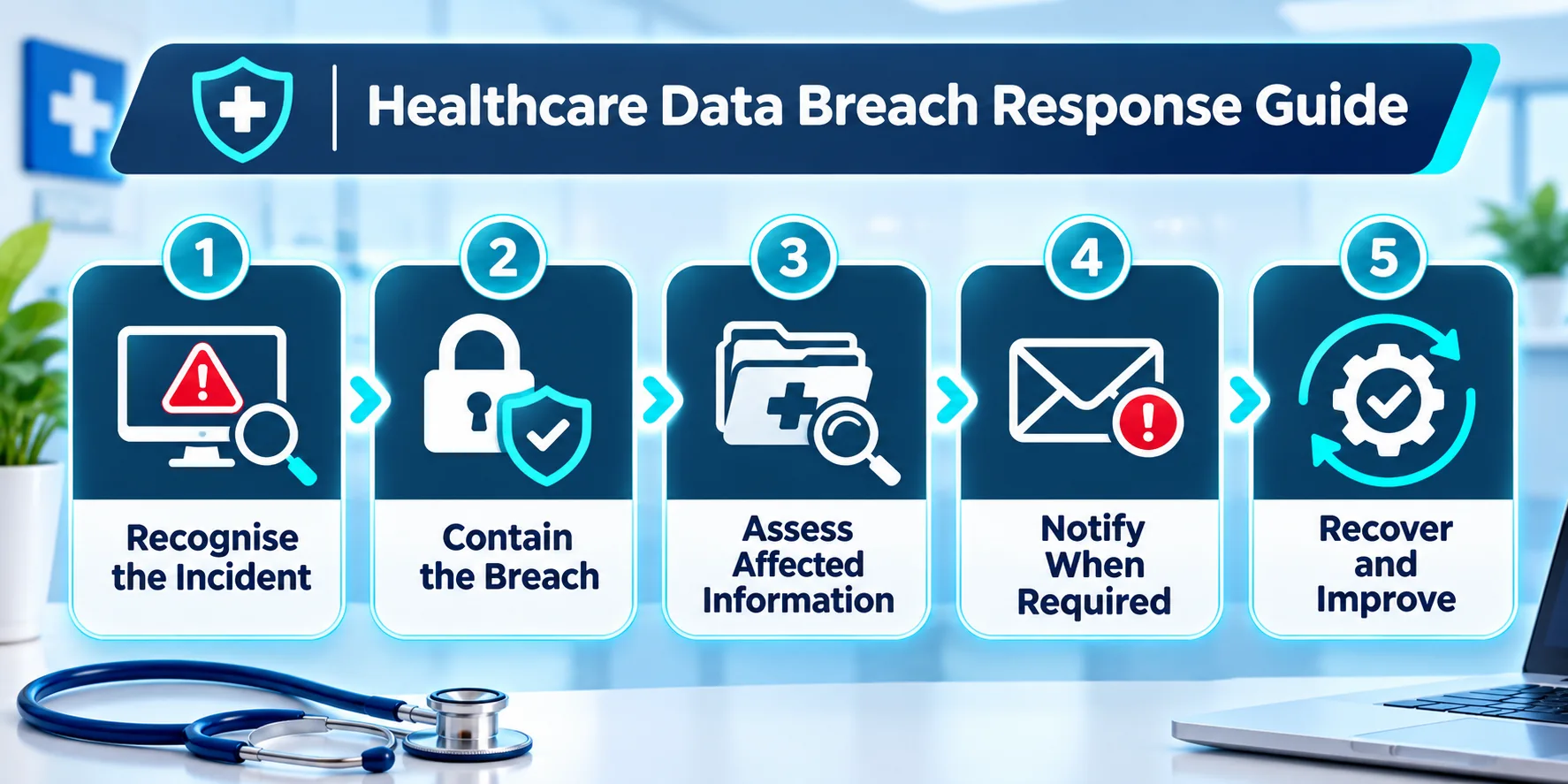
3. Contain the incident without destroying evidence
Containment may involve disabling a compromised account, revoking active sessions, isolating an affected device or restricting network access. These decisions should be coordinated with your technical response team. Avoid indiscriminate deletion, reinstallation or resetting that could remove useful forensic information.
Preserve relevant logs and maintain a clear record of actions taken. If a supplier operates the affected system, establish who is responsible for containment, evidence collection and communications.
4. Keep essential clinical services running safely
Cyber incidents can disrupt appointments, pathology results, prescriptions, referrals and access to medical histories. The practice manager and clinical lead should assess which services can continue safely, which require alternative workflows and when care may need to be rescheduled or redirected.
Three parallel responsibilities
Do not use unapproved personal email, messaging accounts or unsecured devices as an improvised substitute for clinical systems. Document any temporary process and protect patient information throughout.
5. Determine what patient information may be affected
Identify whether personal information was lost, accessed, disclosed or merely at risk. Review relevant evidence such as access logs, sharing settings, device encryption, account activity and supplier findings. Separate confirmed facts from assumptions.
| Question | Why it matters |
|---|---|
| Which records or systems were involved? | Defines the possible scope of exposure and operational impact. |
| What types of information were affected? | Health information can be especially sensitive. |
| Was the information actually accessed or disclosed? | Helps distinguish exposure from confirmed unauthorised access. |
| Was the information encrypted or otherwise protected? | May affect the assessment of likely harm. |
| What remedial action has been taken? | Relevant to assessing and reducing potential harm. |
6. Understand Australian notification obligations
Under Australia's Notifiable Data Breaches (NDB) scheme, an eligible data breach generally involves unauthorised access to or disclosure of personal information, or loss of information in circumstances likely to lead to unauthorised access or disclosure, where serious harm is likely and remedial action has not removed that likelihood. The exact legal test must be applied to the facts.
Where an entity has reasonable grounds to suspect an eligible data breach, it must conduct a reasonable and expeditious assessment and take all reasonable steps to complete it within 30 calendar days. This is an assessment period, not a general permission to wait 30 days before responding. If an eligible data breach is established, notification obligations to the OAIC and affected individuals apply as soon as practicable.
My Health Record participants may also have separate reporting requirements. Contractual duties, professional responsibilities and applicable state laws may need consideration. Obtain privacy or legal advice appropriate to the incident.
A phishing email that was blocked is not automatically a notifiable data breach. Equally, restoring a system after ransomware does not establish that patient information was safe. Reporting decisions depend on evidence, likelihood of serious harm and applicable legal requirements.
7. Recover securely and prevent recurrence
Restore systems only after your technical team has addressed the suspected entry point and confirmed a safe recovery approach. Use known-good backups, validate clinical data integrity, rotate compromised credentials where necessary and monitor for renewed suspicious activity.
Before returning to normal operations
Hold a short lessons-learned review covering the timeline, root causes, patient-care impacts, notification decisions, supplier performance and improvement owners. Update and rehearse the response plan.
Common healthcare data breach scenarios
A staff email account is compromised
Revoke sessions and secure the account with expert assistance. Review forwarding rules, sent items and access logs; assess whether patient correspondence or attachments may have been accessed.
A laptop containing patient information is lost
Confirm device ownership, encryption, remote-management status and what information was stored locally. Assess whether unauthorised access is likely and whether remote protective measures are appropriate.
A clinical software provider reports an incident
Request a written impact assessment, relevant timelines, affected data categories, containment actions and the division of notification responsibilities. Do not assume the supplier's response automatically satisfies the clinic's own obligations.
Frequently asked questions
Does every cyber incident need to be reported to the OAIC?
No. Reporting under the NDB scheme depends on whether the legal criteria for an eligible data breach are met. Other reporting obligations may still apply.
Do we have 30 days to notify patients?
No. The NDB scheme includes an assessment requirement for suspected eligible breaches, with reasonable steps to complete the assessment within 30 calendar days. Notification of an established eligible breach must occur as soon as practicable.
Should staff switch off every computer?
Not automatically. Uncoordinated shutdowns can interrupt care and remove volatile evidence. Follow advice from your technical incident-response team.
Can a small GP clinic have a serious data breach?
Yes. Even a small practice may hold highly sensitive patient information and rely on systems whose loss affects clinical care.
Is your healthcare practice prepared for a cyber incident?
Veytrix Cyber Security helps Australian GP clinics, medical centres and allied health providers assess cybersecurity risks, review incident readiness and prioritise practical improvements. Sydney onsite and Australia-wide remote services are available.
Request a consultation →Official guidance and further reading
- OAIC — Notifiable Data Breaches
- OAIC — When to report a data breach
- Australian Cyber Security Centre
- Australian Digital Health Agency — Cyber security
Important: General information only. This article is not legal advice, an incident investigation, a regulatory compliance certification or a guarantee of protection. Verify current guidance and seek appropriate professional advice for an actual incident.